Digital Waste Tracking for receiving sites
Digital waste tracking, built for the receiving site.
Capture, validate and approve waste receipts before preparing them for Digital Waste Tracking. Waste Relay keeps site work, submission status and evidence connected.
Founder-supported, invite-only pilots for supported non-hazardous receipts in England and Wales.
The operational problem
Make receipt quality visible before it becomes a submission problem.
Digital Waste Tracking turns each receipt into a record you will be asked to stand behind. Most of the difficulty is not the reporting itself. It is what happens on site before it.
Missing or inconsistent receipt information
A carrier, EWC code or weight is left incomplete, and nobody notices until the receipt is due to be reported.
Problems found too late
Issues surface at the point of submission, after the vehicle has left and the person who knew the answer has gone home.
No clear view of what still needs attention
Which receipts are waiting on capture, which on approval and which on Defra is spread across people and spreadsheets.
Internal approval and Defra state get confused
Approved by the site and accepted by Defra are different facts. Treating them as one hides movements that have not been reported.
Evidence drifts away from the receipt
What was approved, what was sent and what Defra returned end up in separate systems, emails and folders.
How Waste Relay works
One receipt, one sequence of explicit stages.
Capture, approval and submission remain distinct. Nothing is sent to Defra until a person chooses to send it; the response and resulting evidence are recorded against the receipt.
Capture
Record the receipt, waste items, EWC codes, disposal or recovery allocation and carrier details against the receiving site and its authorisation.
Validate
Blocking errors, warnings and information findings are listed before the receipt can progress, with a link to the field that needs fixing wherever the reader can edit it.
Approve
Operational capture and compliance approval are separate stages. A receipt is marked ready, then approved by someone with approval authority.
Defra readiness
Check the approved receipt against Defra's requirements and reference data before anything is sent. The check creates nothing at Defra.
Prepare
Freeze the approved receipt into a controlled submission snapshot, so what is sent cannot drift from what was approved.
Submit
Send the prepared submission to Defra's Receipt of Waste service as a deliberate, recorded action.
Confirm
Defra's response is recorded against the receipt. When a submission is accepted, the Waste Tracking ID is stored with it.
Evidence
The receipt, its approval history, its corrections and every submission outcome stay together on one evidence page, with a CSV export.
Inside the product
Built from the receipt outwards.
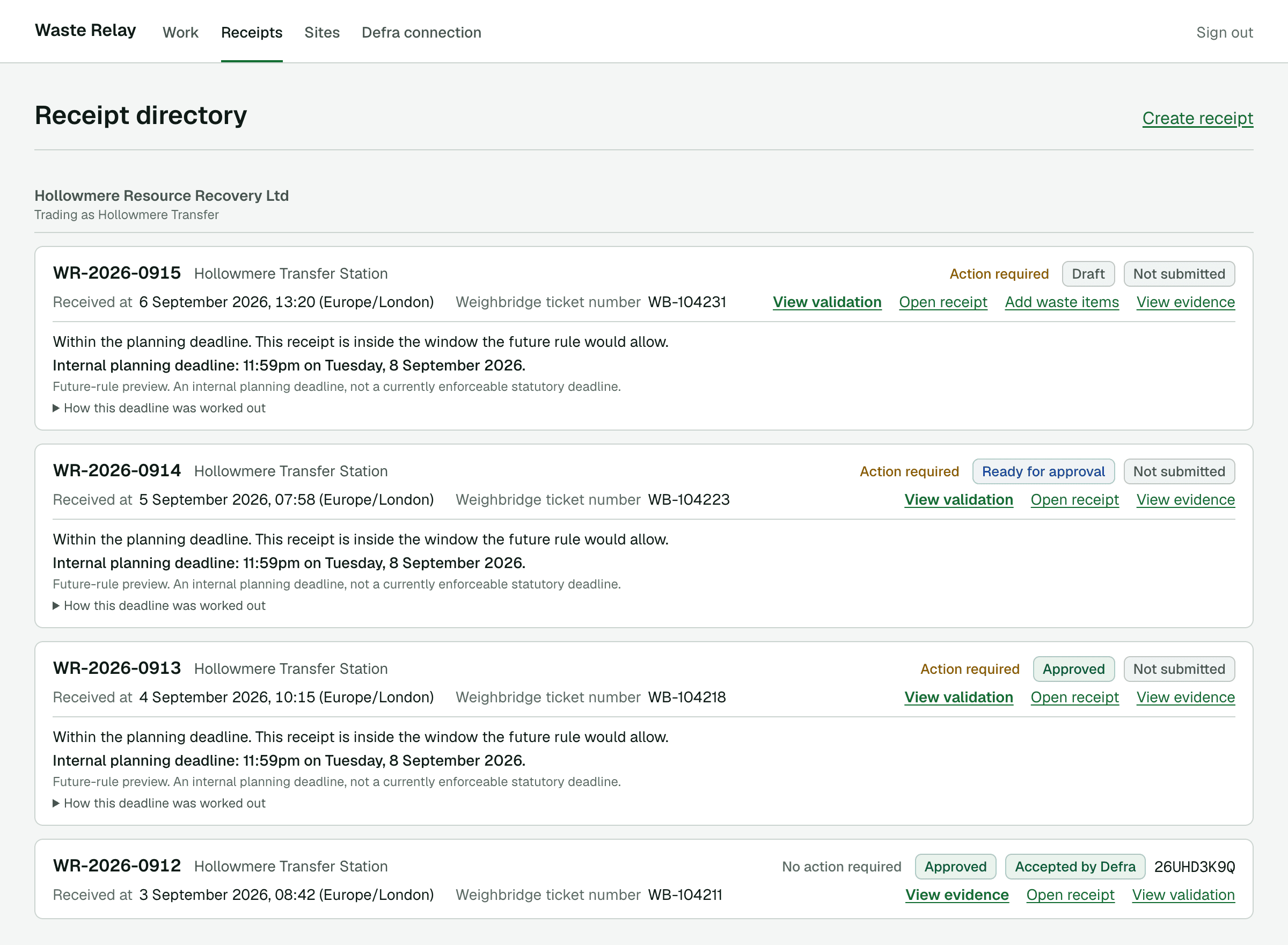
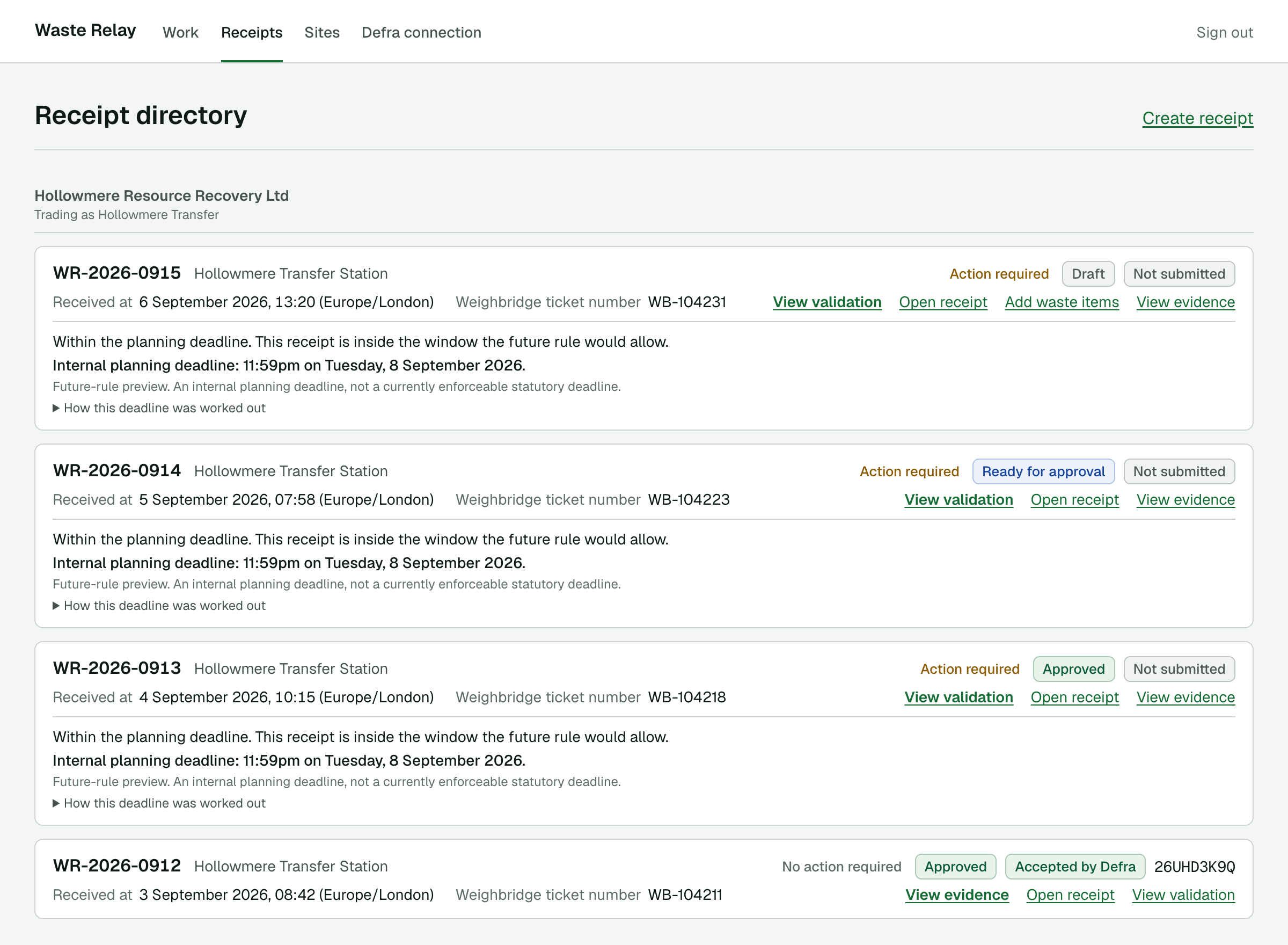
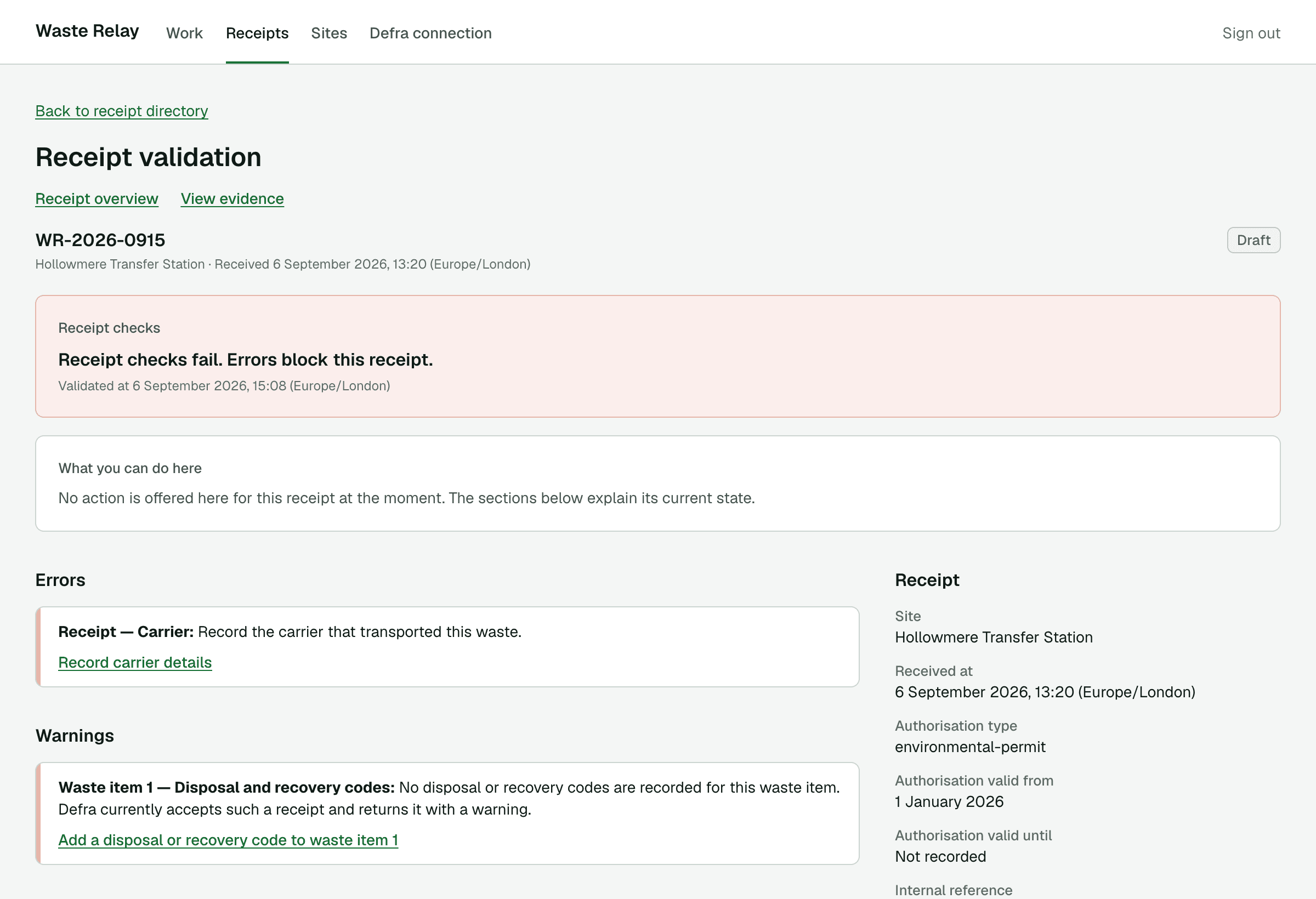
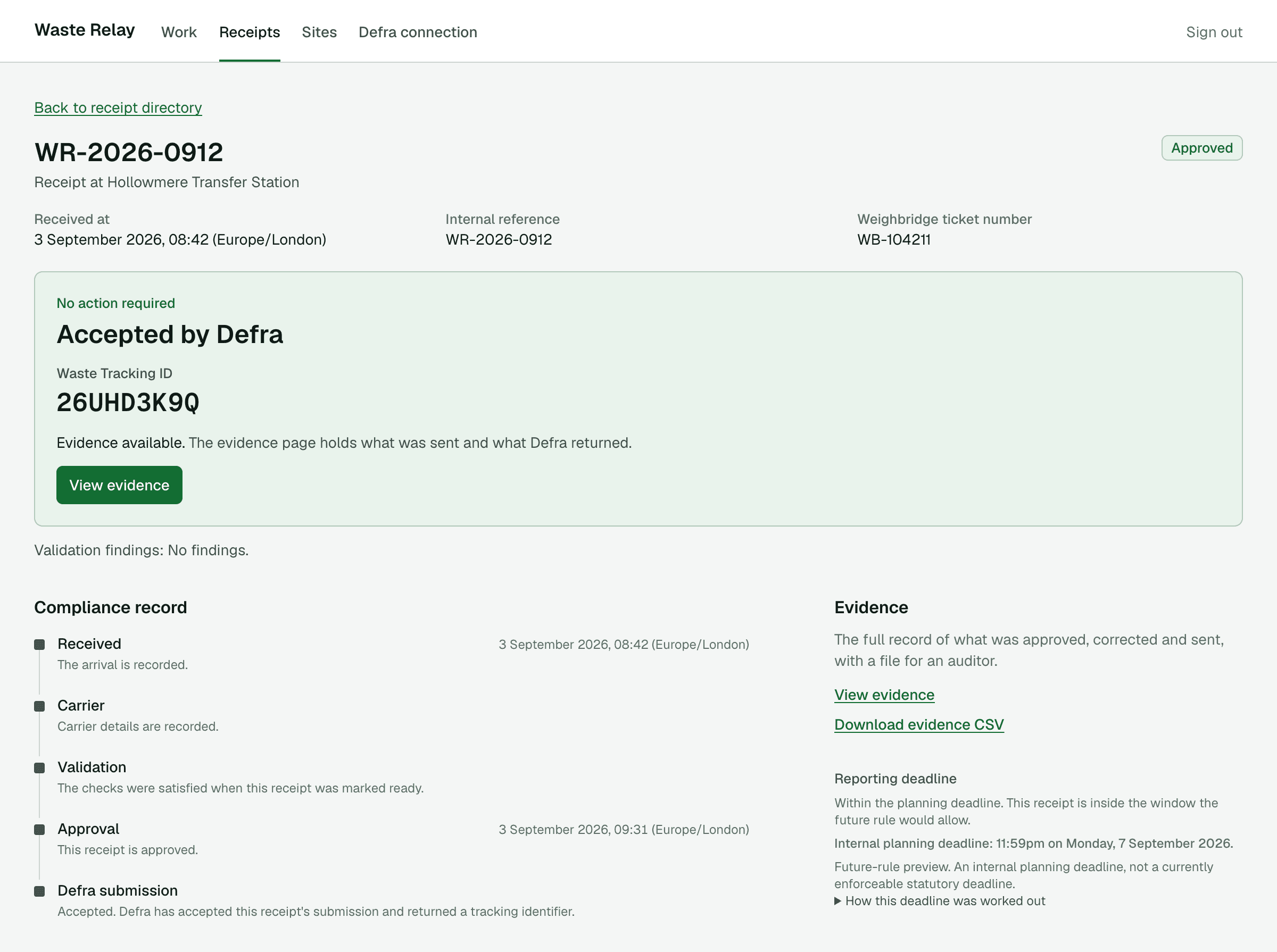
These are screens from the current product, shown with illustrative example data from a test organisation. The Defra outcome and Waste Tracking ID shown are examples, not a live Defra record.
Validation
Fix problems before the receipt moves forward.
Blocking findings, warnings and correction destinations stay attached to the receipt being reviewed.
View full-size validation (example data)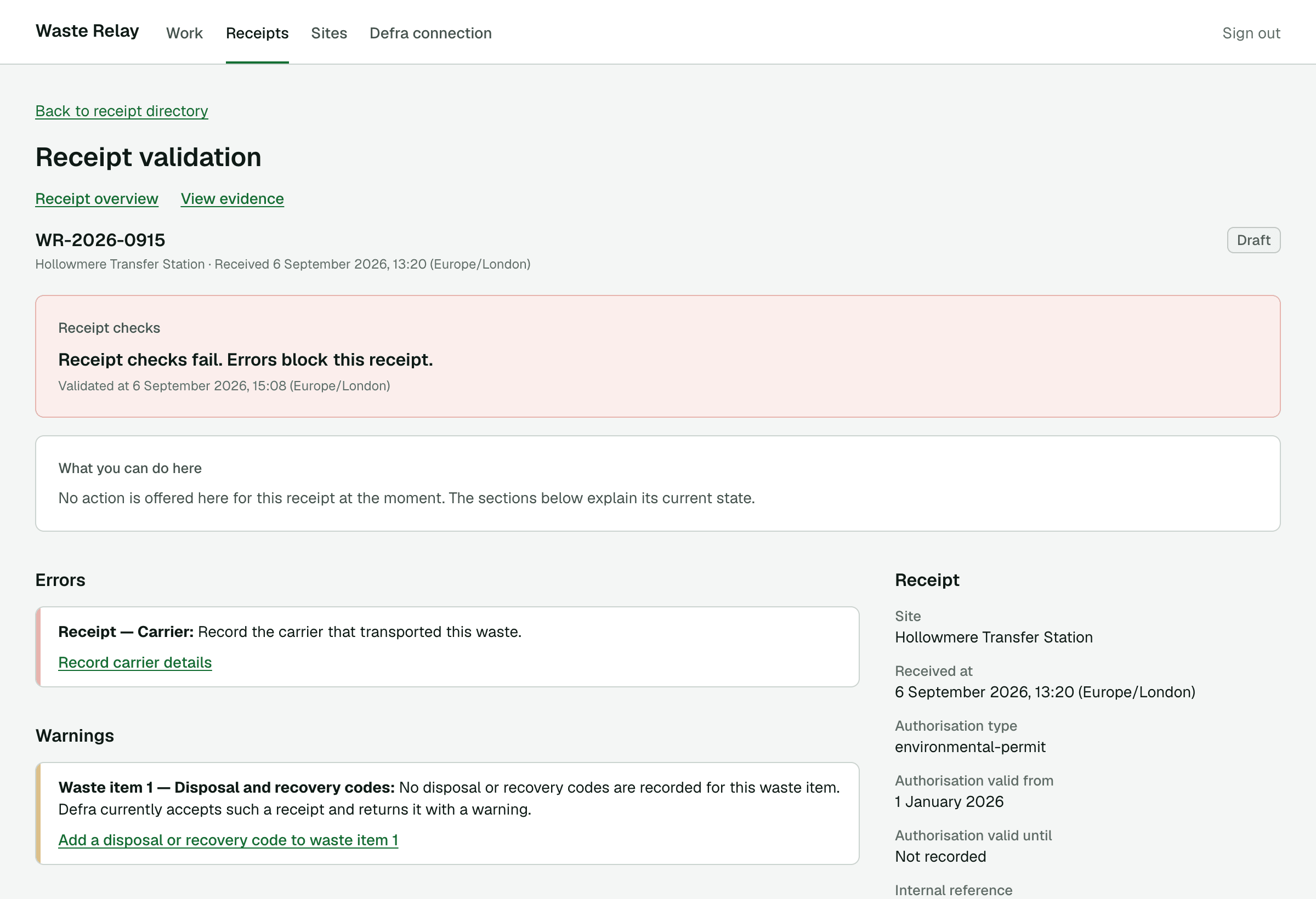
Accepted
Keep confirmation attached to the record.
When Defra accepts a supported submission, the Waste Tracking ID and evidence remain connected to that receipt.
View full-size confirmation (example data)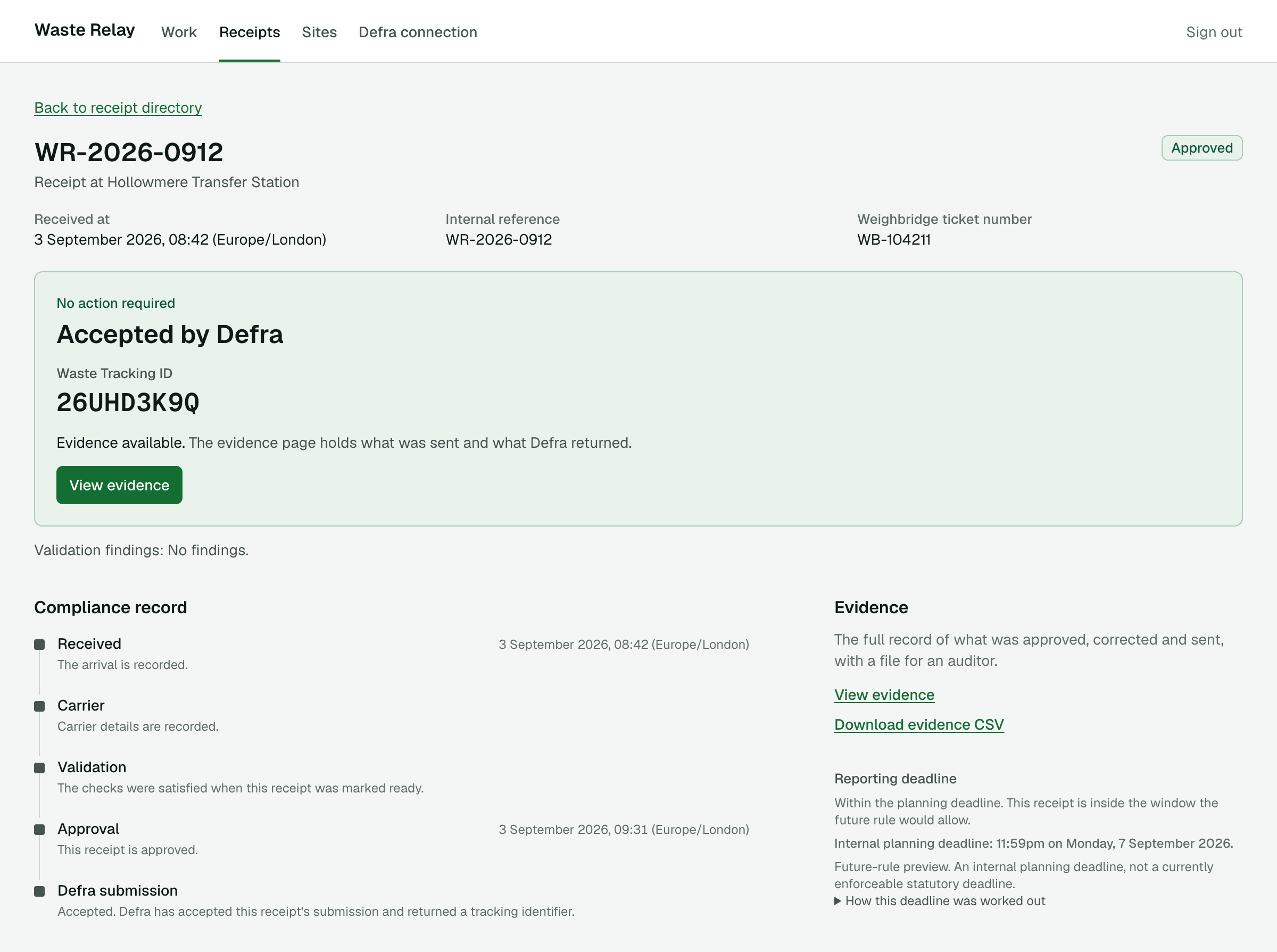
Who it's for
Built initially for UK waste-receiving operations.
Waste Relay is for the people who receive waste and have to account for it: the site manager capturing the load, the compliance manager approving it, and the operations manager who needs to know what is still outstanding.
- Waste transfer stations
- Recycling facilities
- Materials recovery facilities (MRFs)
- Other permitted waste-receiving sites using the supported workflow
Current scope
Initial pilots focus on supported non-hazardous receipt workflows at sites in England and Wales. Hazardous waste, waste containing POPs, and broker or dealer reporting are outside the current scope. A receipt marked hazardous or containing POPs is blocked before submission rather than filed incorrectly.
Pilot programme
Help shape Waste Relay with us.
We are selecting a small number of UK waste operators for founder-supported pilots while the Defra integration is taken through Defra's test and approval process.
Use Waste Relay alongside your current process, test the workflow with representative or shadow receipts, and tell us where it does, and does not, fit day-to-day site operations.
During the pilot, Waste Relay does not replace your existing statutory reporting process or make production Defra submissions until the relevant production approval and readiness gates are complete.
Founder-supported setup
Sites, authorisations and accounts set up with you, not left to a help centre.
Alongside your existing process
Nothing you do today stops. The pilot runs in parallel with your current records.
Realistic operator feedback
We want to know what gets in the way of a shift, not only what looks good in a demo.
Direct influence on the early product
Pilot findings shape what is built next.